Avery Bennett · 22 November 2026
Adapting Support Escalation Workflows to Sustain Response Accuracy Amid Surging User Volumes at Growing Digital Service Providers
Growing digital service providers face mounting pressure when user volumes spike and support teams must maintain precision in every response, and data from industry monitoring shows that platforms handling millions of daily interactions often restructure their escalation paths to prevent bottlenecks while preserving detail accuracy in technical resolutions.
Those who've studied these environments note that traditional linear support models break down once monthly active users exceed certain thresholds, since each query layer adds potential points where information can degrade if handoffs lack standardized documentation protocols, and companies therefore introduce multi-tier escalation frameworks that route simple issues through automated filters while directing complex cases to specialized agents with access to updated internal knowledge repositories.
Core Components of Updated Escalation Structures
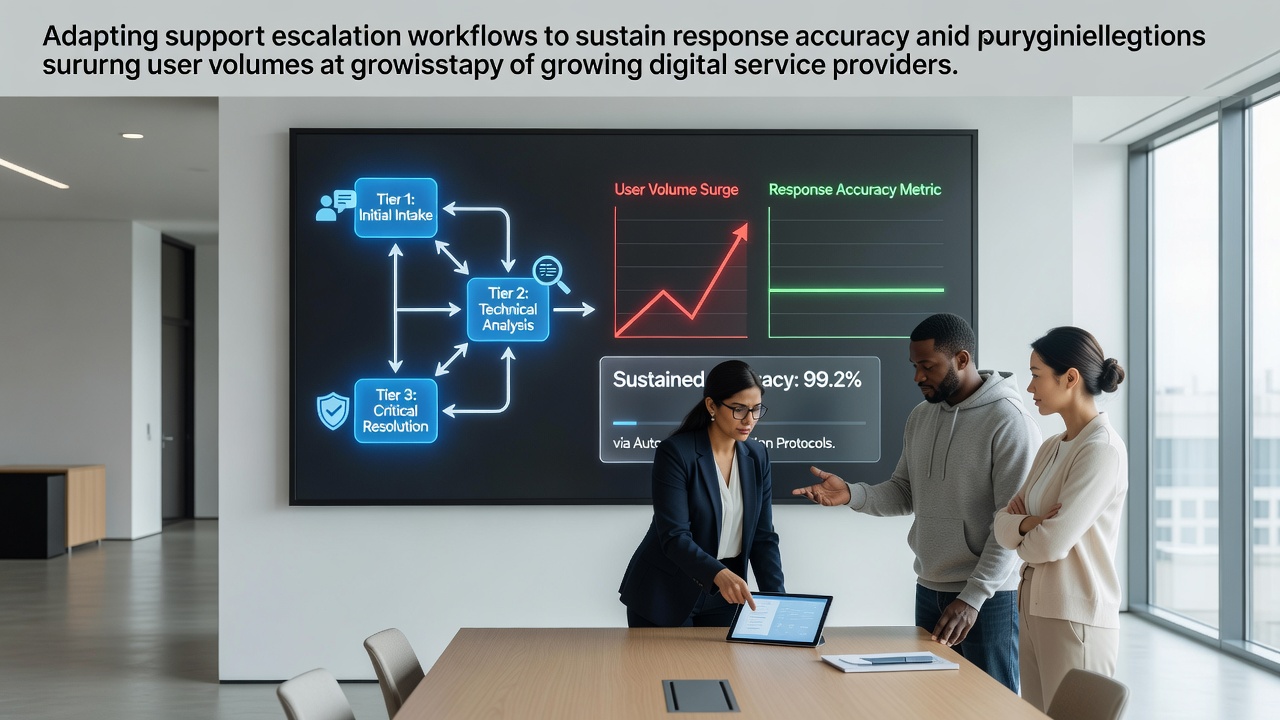
Research indicates that effective adaptations begin with clear tier definitions where level-one agents handle initial triage using scripted decision trees, level-two specialists receive cases flagged for deeper diagnostics, and level-three engineers engage only when patterns suggest systemic issues, yet this structure succeeds only when each transition includes mandatory context summaries that capture user history, prior attempts, and error logs in consistent formats.
Observers note that providers operating in November 2026 reported measurable gains after embedding real-time collaboration tools that allow agents across tiers to co-edit resolution notes simultaneously, and this approach reduces duplication while ensuring accuracy remains high even as ticket volumes climb during product launches or seasonal peaks.
Role of Automation and Data Integration
Automation enters the workflow through intelligent routing engines that analyze query metadata against historical resolution databases, and figures from platform analytics reveal that such systems can deflect up to forty percent of routine inquiries before they reach human agents, freeing capacity for the remaining volume that requires nuanced judgment. But here's the thing: accuracy holds only when automation rules undergo frequent audits against fresh user feedback loops, because outdated triggers quickly introduce mismatches between problem descriptions and assigned categories.
Those managing these systems often integrate customer relationship data with internal telemetry feeds so that escalation decisions incorporate usage patterns rather than isolated ticket text alone, and this layered view helps teams identify whether a reported glitch stems from an individual configuration or a broader deployment change affecting thousands of accounts simultaneously.

Training Protocols and Knowledge Retention
Staff development programs shift toward scenario-based simulations that replicate high-volume surges, and evidence from training evaluations shows participants retain procedural knowledge longer when exercises include live data streams instead of static examples. Providers further reinforce retention by maintaining living documentation that agents update after each resolved case, creating an evolving reference that reflects the latest product behaviors and common failure modes.
Cross-functional rotations place support personnel alongside product and engineering teams for short periods, allowing direct exposure to development priorities and release schedules, while this exposure sharpens the ability to escalate with precise technical framing that accelerates downstream investigation.
Performance Metrics and Adjustment Cycles
Key performance indicators expand beyond average response time to include resolution accuracy scores derived from post-interaction surveys and internal peer reviews, and reports compiled across multiple providers demonstrate that platforms tracking both speed and correctness achieve steadier user satisfaction ratings during growth phases. Continuous adjustment cycles rely on weekly reviews of escalation logs to spot recurring misroutes or knowledge gaps, after which teams revise routing logic or training modules accordingly.
One study revealed that digital service companies adopting these review cadences saw a twenty-five percent drop in repeat escalations within six months, illustrating how iterative refinement compounds over successive user-volume increases.
Conclusion
Digital service providers continue refining escalation workflows through structured tiers, targeted automation, integrated data sources, and ongoing training, and the combined effect sustains response accuracy even when user bases expand rapidly. External analyses from organizations such as NIST and the European Commission digital strategy reports underscore the value of documented processes that scale without sacrificing precision in technical communications.